
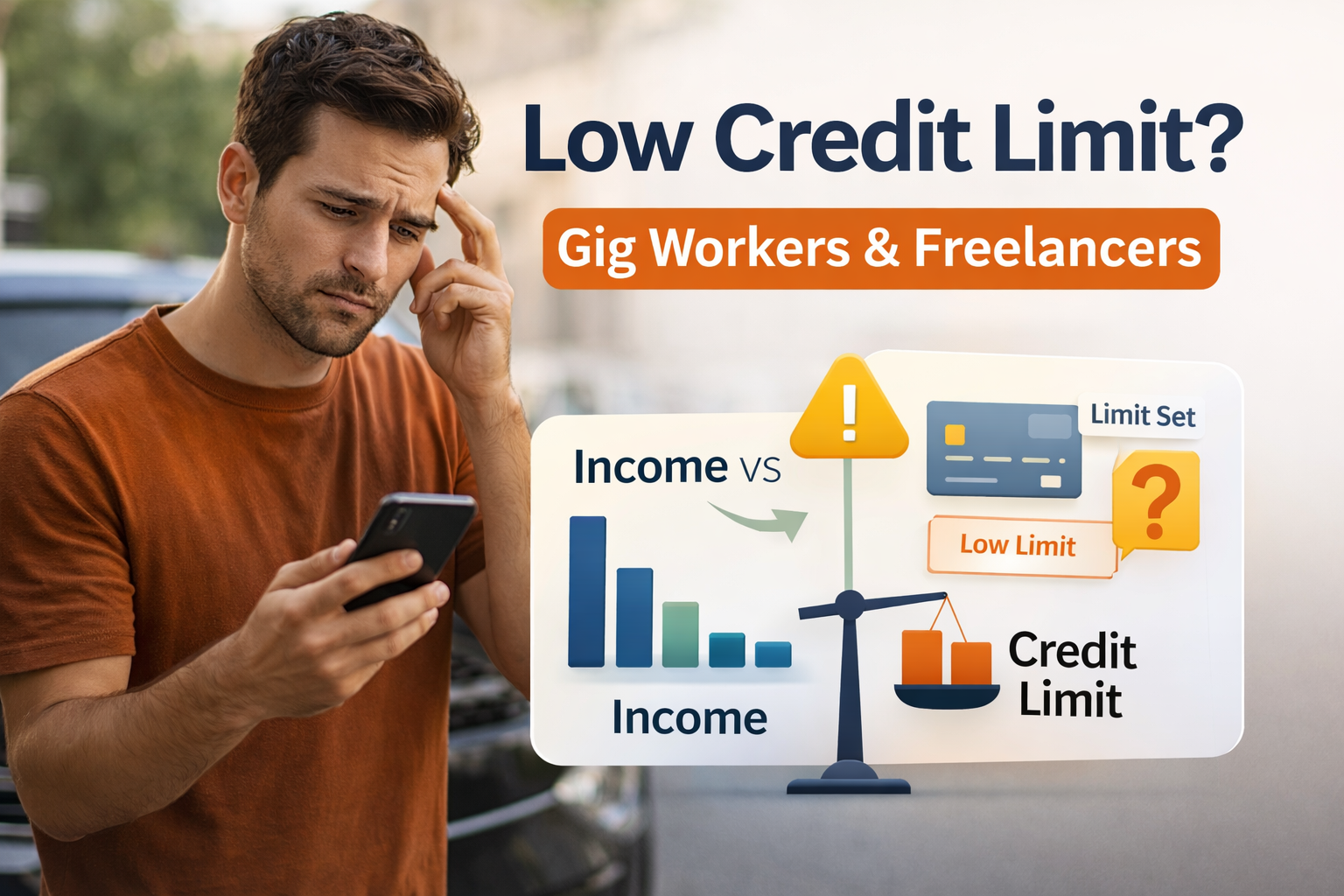
how credit limits are set for gig workers and freelancers depends on how lenders evaluate income, risk, and financial stability.
Introduction
For independent workers, that single sentence often translates into a lot of uncertainty. You might apply for a card, get approved quickly, and then see a credit limit that feels far lower than what your actual income would justify—or watch someone with similar earnings end up with a very different limit.
Credit limits matter because they shape how flexible your financial life can be. A higher limit can help smooth out uneven cash flow, cover large business expenses, and keep your credit utilization ratio in a healthier range. A lower limit, on the other hand, can make it harder to separate business and personal spending, and can cause your utilization to spike with just a few necessary purchases.
Freelancers and gig workers face extra confusion because traditional credit systems were built around steady paychecks, not variable invoices, contracts, and platform payouts. Underwriting models tend to favor predictable income from a single employer, so when your deposits rise and fall from month to month, it is not always obvious how a lender will interpret that.
This article walks through how credit limits are actually set for gig workers and freelancers in the US, what lenders look for, and what you can do to build toward a stronger credit limit over time. If you’re new to credit fundamentals, it helps to first understand the basics in our guide on how credit cards work in the US.
What Is a Credit Limit
A credit limit is the maximum amount a lender allows you to borrow on a revolving credit line at one time. On a credit card, it is the ceiling you can charge before additional transactions start getting declined or fees and restrictions kick in.
Unlike a fixed loan amount, which you receive once and pay down over time, a revolving limit is reusable. As you pay down your balance, your available credit goes back up, as long as the account remains in good standing. That revolving structure is why lenders are cautious: at any given moment, you could use the full line.
Credit limits differ from person to person because they are risk-based decisions rather than flat amounts. Two people with the same income can see very different limits if one has a long record of on-time payments and low debt, while the other carries high balances and has a history of late payments. The limit is the lender’s way of balancing usefulness for you with acceptable risk for them.
For gig workers and freelancers, the core idea is the same as for salaried workers: a limit reflects how confident the lender is that you can handle that level of borrowing without defaulting. The difference lies in how they read your income and stability.
How Lenders Decide Credit Limits
Although each lender uses its own models, most look at a similar set of building blocks when deciding your initial credit limit and future increases.
Income level
Income is the starting point because it reflects your capacity to repay. When you fill out an application, the lender uses your stated income—often combined with information from your credit reports—to estimate how much room you have in your budget for new payments.
A higher income generally supports the possibility of a higher limit, but there is no simple formula that says a certain income always leads to a specific number. Lenders care at least as much about what is left after other obligations as they do about the top-line figure.
Income consistency
For independent workers, consistency is often the bigger issue than absolute income. Traditional underwriting favors predictable paychecks that arrive on a regular schedule. Gig work, by contrast, may bring one very strong month followed by a slow one, or heavy earnings in one season and lighter income in another.
To manage that variability, lenders often look at average income over time rather than a single recent spike. They may use bank statements, tax returns, or both to estimate your typical inflow and to see whether your income tends to rise, fall, or stay roughly stable. The more predictable your pattern appears, the more comfortable many lenders feel with higher limits.
Credit score
Your credit score condenses your past behavior with credit into a number. It reflects how reliably you make payments, how much of your available credit you use, how long you have had accounts, the mix of credit types, and how often you apply for new credit.
A stronger score signals lower risk from the lender’s perspective. That can open the door to both approvals and higher starting limits. A weaker score, even with decent income, can lead to lower limits because it suggests a higher chance of missed payments or default.
Existing debt and debt-to-income ratio
Lenders also consider how much debt you already have relative to your income, often summarized as a debt-to-income (DTI) ratio. DTI compares your required monthly debt payments—on credit cards, personal loans, auto loans, and other obligations-to your gross monthly income.
If a large portion of your income is already committed to existing debts, a lender may cap your credit limit at a lower amount to avoid stretching you too far. From their point of view, the more of your income that is spoken for, the less capacity you have to safely manage an additional line.
Credit utilization
Credit utilization is how much of your existing revolving credit you are using at a given time, typically expressed as a percentage across all your cards. If you have total limits of 10,000 and balances of 4,000, your overall utilization is 40 percent.
High utilization, especially over time, can be interpreted as a sign that you rely heavily on credit and may be at greater risk of payment trouble. Low utilization suggests you manage your lines conservatively and are less likely to overextend yourself. This factor matters both for your credit score and for how a lender views you when setting limits.
In simple terms, credit limits are based on income stability, existing debt, and how responsibly you manage your current credit. To understand how credit reports and borrowing behavior impact lending decisions, you can refer to official resources like Annual Credit Report information.
Key factors at a glance
| Factor | Impact on Credit Limit |
|---|---|
| Income | Higher income supports higher limits |
| Consistency | Stable income increases trust |
| Credit Score | Strong score increases limit |
| Debt (DTI) | High debt lowers limit |
| Utilization | Lower usage improves chances |
You can also learn how your credit score impacts approval and limits in our guide on how credit score affects credit card approval.
Income and Credit Limits
Many freelancers assume that as long as their total income is strong, their credit limit should automatically be high. In reality, the income and credit limit relationship is more complex. Income and credit decision factors are also explained in trusted financial education resources such as the Consumer Financial Protection Bureau credit card guide.
A higher income does not always mean a higher limit. If your credit score is modest, your DTI is high, or your reports show frequent late payments, a lender may keep your line low despite solid earnings. On the other hand, someone with moderate income but excellent credit habits, low utilization, and little existing debt may receive a surprisingly generous limit.
For gig workers and freelancers, stability usually matters more than peak income. A year with several big project payouts and multiple lean months can look riskier than a year with steady, mid-range earnings. Lenders want to know that you can comfortably make payments in slower periods, not just when business is booming.
Lenders also tend to think in monthly terms, even when they ask for annual income. They effectively translate your annual figure into an average monthly amount, then compare it with your recurring obligations to gauge capacity. Understanding how credit limits are set for gig workers and freelancers requires focusing on income consistency rather than just total income.
For independent workers, that means how you structure and document your income can matter as much as the headline number on your invoices. Understanding how credit limits are set for gig workers and freelancers helps explain why income consistency matters more than peak earnings. To better understand how income verification impacts approval decisions, read our detailed guide on bank statements vs tax returns credit card approval.
Gig Workers and Freelancers: Unique Challenges
Gig workers and freelancers face the same general rules as salaried borrowers, but the way their finances appear on paper can make the process more complicated. This is the core of why a credit limit for freelancers in the US often starts lower than expected.
Irregular income
Project-based contracts, platform-based gigs, and seasonal work all create uneven inflows. One month might bring several large payments, while the next month is mostly prospecting or waiting on clients. From a lender’s perspective, that irregular pattern makes it harder to predict whether you will always have enough cash to cover minimum payments.
Even if your yearly income is strong, sharp swings between months can lead a lender to take a cautious approach with your starting limit.
Multiple income sources
Many independent workers piece together earnings from multiple clients, platforms, and side projects. In real life, that diversification can lower your risk: if one source slows down, others might keep flowing. But on an application or a quick review of statements, it can look fragmented and harder to interpret.
Because many underwriting systems are built around a single primary employer, multiple smaller income streams may push lenders to lean more heavily on documents like bank statements and tax returns to build a complete picture.
Higher perceived risk
Traditional models treat long-term employment with a single employer as the lowest-risk pattern. When you are self-employed, work on short-term contracts, or rely on gig platforms, lenders may see you as higher risk simply because your situation does not fit that traditional mold.
That higher perceived risk can show up as lower initial limits, more conservative responses to a limit increase request, or extra scrutiny of your income documentation. Over time, consistent on-time payments and careful credit use can help offset that perception.
Deposit and cash-flow patterns
Beyond the numbers you type into the income field, many lenders pay attention to the flow of money through your accounts. They may look for patterns such as:
- How often deposits hit your account
- The typical range of those deposits
- Whether your balance regularly dips very low or negative
- How frequently you move money between personal and business accounts
For a gig worker credit card limit, consistent, traceable deposits and positive balances can help reassure a lender that your cash flow is manageable even if individual months vary. Long gaps between deposits or frequent overdrafts can have the opposite effect.
Role of Bank Statements and Tax Returns
Because independent income does not come with a simple pay stub, bank statements and tax returns often play a larger role in how lenders decide credit limits for freelancers and gig workers.
Bank statements: recent income and behavior
Bank statements give a near-term snapshot of your financial life. They show:
- Recent deposits and where they came from
- How frequently money comes in
- How quickly it is spent or transferred out
- Whether your balance regularly goes negative
For self-employed applicants, some lenders use several months of statements to estimate current income and to assess how you manage day-to-day cash flow. Even if you are not asked to upload statements with a credit card application, similar information may be used when you apply for higher lines of credit elsewhere, so it is worth treating those patterns as important.
Tax returns: long-term stability
Tax returns provide a longer-range view of income. For freelancers and gig workers, lenders may look at net profit over one or more years, rather than focusing on gross revenue before business expenses.
If returns show that your income has been stable or rising across multiple years, that can support a higher freelancer credit card approval limit over time. If income has declined or bounced widely from year to year, a lender may stay more conservative even if your most recent months look strong.
In short, bank statements tend to highlight recent income and behavior, while tax returns help demonstrate long-term stability and earning power. Together, they tell the story of your financial life from two different angles.
Typical Credit Limit Ranges
Every lender sets its own internal ranges, but independent workers often fall into a few broad patterns when they first receive a card or apply for a new line. These are not promises or guarantees, just common tendencies in how credit limits are set for gig workers and freelancers.
Beginner or thin-file profiles
If you are new to credit, have only one or two accounts, or have only recently started freelancing, your initial limit may be on the low side. With limited credit history and a short self-employment track record, lenders have less data to work with, so they err on the side of caution.
Here the goal is to see how you handle a smaller line: do you pay on time, keep utilization contained, and avoid red flags? If so, you may see periodic limit increases or be in a stronger position to request one later.
Moderate or growing profiles
With a few years of credit history, a record of on-time payments, and a more established freelance or gig income, you are more likely to see moderate limits that feel usable for everyday business and personal expenses.
In this range, behavior often matters as much as income. Keeping overall utilization low, avoiding unnecessary new debt, and showing consistent deposits can gradually nudge your limits higher over time.
Strong, well-documented profiles
With several years of stable or rising self-employment income, strong credit scores, low DTI, and low utilization, independent workers can receive higher credit limits similar to many long-term salaried borrowers.
At this point, your job label—freelancer, consultant, gig worker—matters less than the overall strength of your profile. Clean statements, solid tax records, and a long track record of responsible credit use all support higher lines.
How to Get Higher Credit Limits
You cannot control every detail of a lender’s internal model, but you can influence most of the inputs it relies on. Over time, these practical steps can improve the odds of a higher limit. You can also explore general credit management advice from official sources like USA.gov credit information.
Keep deposits consistent and traceable
Try to route income through a primary account instead of constantly switching where funds land. If your work is seasonal, consider paying yourself a steady “salary” from your business account to your personal account each month, using savings from stronger months to fill the gaps.
This kind of structure can make your bank statements look more like a predictable income stream and less like a series of spikes and dips.
Reduce existing debt
Paying down high-interest cards or other revolving balances before applying for new credit or asking for a higher limit can improve your DTI and your overall risk profile. Lower total debt means a lender can offer a larger line without pushing you into a level of obligations that looks unsustainable.
For many freelancers, targeting the accounts closest to their limits and then keeping those balances lower going forward is a powerful signal of progress.
Keep utilization low
Even if you pay in full every month, your statement balance might show a high utilization if you charge a lot between statements. Planning payments so that large expenses are paid down before the statement date can help keep reported utilization in a healthier range.
For independent workers who use cards heavily for business, this might mean making multiple payments throughout the month or splitting larger purchases between cards to avoid maxing out any single line.
Build a strong payment history
On-time payments remain one of the most important pieces of any credit profile. Late payments can hurt your credit score and make lenders cautious about raising your limits.
Automating at least the minimum payment, then paying extra manually when cash flow allows, can help you avoid missed due dates during busy stretches of client work. Over time, a long streak of on-time payments is one of the clearest arguments for a higher gig worker credit card limit.
Request increases strategically
Many issuers periodically review accounts and may grant automatic limit increases to cardholders who show responsible use. You can also request an increase directly, especially after:
- A full year or more of on-time payments
- Noticeably higher average income
- Paying down or paying off other significant debts
Before you request a higher limit, it can help to make sure your recent statements show low utilization, consistent deposits, and no overdrafts. For independent workers, timing the request after several strong months rather than after a slow stretch can support a better outcome.
9. Common Mistakes
Even financially savvy freelancers can unintentionally hold themselves back from higher limits. Avoiding a few common pitfalls can make a noticeable difference.
Overstating income
Because income for gig workers fluctuates, it can be tempting to round up aggressively on applications. But if a lender later asks for documentation and finds that your stated income is not supported by tax returns or bank statements, it can hurt your credibility and limit your options.
Using realistic, supportable figures on applications is safer and keeps your credit limit aligned with what you can reliably handle.
Allowing chaotic deposit patterns
Income variability is part of independent work, but disorganized banking does not have to be. Letting invoices pile up without clear timing, moving payments among multiple accounts without a pattern, or constantly mixing business and personal funds can make your financial picture harder to read.
Standardizing where and how you are paid, and keeping clear separation between business and personal banking when possible, helps lenders see the underlying stability in your work.
Keeping utilization high
Regularly running balances close to your limits—even if you avoid outright missed payments—can hurt both your credit score and your perceived ability to manage more credit.
For freelancers who put a lot of expenses on cards, keeping utilization under control may require a mix of spreading costs across accounts, making mid‑cycle payments, and budgeting so that business expenses do not crowd out room for personal needs.
Applying too early
New freelancers sometimes apply for multiple cards right when they go independent, before they have any self-employment history on paper. Without several months of deposits or at least one tax return reflecting your new income, lenders may default to conservative limits and multiple applications can add unnecessary inquiries.
Waiting until you have a few months of documented income and, ideally, a tax filing that reflects your freelance work can improve both approvals and limits.
Weak documentation
Disorganized invoices, missing receipts, or delayed tax filings can all make it harder to prove your true earning power. When a lender asks for additional information, thin or messy documentation can translate directly into lower limits or outright denials.
Building simple systems—such as consistent invoicing, regular bookkeeping, and timely tax returns—supports a stronger story when it is time to request a higher freelancer credit card approval limit.
Why is my credit limit low?
A low limit is often a sign that the lender is being cautious, not that you did something wrong. Common reasons include limited credit history, modest or unstable income, high existing debt, or high utilization on other cards.
For gig workers and freelancers, a short track record of self-employment income or irregular deposit patterns can also lead to conservative limits at first. As your history grows and you show steady payments and responsible usage, you can usually work toward higher lines over time.
Can freelancers get high limits?
Yes. Freelancers and gig workers can qualify for high limits when their overall profiles are strong: good credit scores, several years of stable or rising income, low DTI, and low utilization.
In many cases, once your documentation and behavior look similar to that of a long‑term salaried borrower, your job title becomes less important than the numbers on your reports and statements.
Does income proof affect credit limits?
Income proof can significantly influence how lenders decide credit limits for self-employed applicants. When a lender can clearly see that your income is both real and reasonably consistent, it becomes easier to justify a higher line.
Bank statements, tax returns, and other records help lenders move beyond a self-reported number and evaluate patterns over time. For a gig worker or freelancer, strong documentation can be the bridge between a cautious starting limit and a line that better reflects your actual earning power.
For many applicants, how credit limits are set for gig workers and freelancers becomes clearer when income patterns and documentation are aligned.
Conclusion
Credit limits for independent workers are not random. They reflect how lenders interpret your income, debt, and credit behavior through models that were originally designed around traditional employment.
By focusing on consistent, well-documented income, managing existing debt, keeping utilization low, and building a solid payment history, gig workers and freelancers can gradually move from modest starter limits to more substantial lines that support both business needs and personal stability.
Understanding how credit limits are set for gig workers and freelancers helps applicants improve their chances of getting higher limits by showing consistent and reliable income. For more practical guides and deeper insights, you can explore related articles across our site.
Disclaimer
This article is for educational purposes only and does not constitute financial, legal, or tax advice. Credit policies, underwriting standards, and limit decisions vary by lender and may change over time. Always consider your own financial situation and, when needed, consult a qualified professional before making credit decisions.