
Introduction
If you’ve ever applied for a credit card as a freelancer, you’ve probably experienced the paradox: the IRS considers your income real enough to tax, but credit card companies seem to treat it as imaginary. You might be earning $50,000 a year while your salaried friend making $40,000 gets approved without question. The confusion stems from a fundamental difference in how credit card issuers assess income stability and predictability.
Unlike a traditional salaried employee who receives a consistent paycheck on the same day each month, freelancers face the reality of irregular income patterns, multiple income sources, and payment timing that varies by client. This creates a challenge for credit card companies trying to evaluate whether you can reliably pay your monthly bill. The key to understanding the credit card application process is learning how credit card companies evaluate freelancer income—and recognizing that their concerns are less about how much you earn and more about when and how consistently that income arrives.
On This Page
- Introduction
- How Credit Card Companies Evaluate Freelancer Income
- Why Consistency Matters More Than High Income
- Types of Freelancer Income Credit Card Companies Consider
- How Credit Card Issuers Evaluate Irregular Freelancer Income in Practice
- Documents That Help Support Freelancer Income
- Common Mistakes Freelancers Make When Reporting Income
- Real-World Examples of Freelancer Income Evaluation
- Conclusion
- Frequently Asked Questions
How Credit Card Companies Evaluate Freelancer Income
When you apply for a credit card, the issuer must assess how lenders assess ability to repay before approval. This requirement comes from the Credit Card Accountability, Responsibility, and Disclosure (CARD) Act of 2009, federal legislation designed to protect consumers from predatory lending. The evaluation process is more nuanced than simply checking a number on your tax return.
The Stated Income vs. Verified Income Process
Most credit card issuers accept stated income on your application without immediate verification. You report your monthly or annual income, and in many cases, that’s the figure they use to assess your initial creditworthiness. However, the issuer doesn’t stop there. They employ a process called income modeling, where they cross-reference your stated income against patterns visible in your credit report and financial behavior. Think of it as a credibility check: does your spending, credit-taking, and existing debt patterns suggest your income claim is realistic?
For example, a credit analyst reviewing your application might flag an inconsistency if you report earning $250,000 annually but recently took out a car loan for only $14,000 over seven years. The mismatch between claimed income and actual borrowing behavior raises questions about whether the stated income is accurate.
Income Patterns and Predictability
The fundamental difference between how issuers view salaried versus freelance income comes down to predictability. A salaried employee’s income is stable by design—the same amount arrives on the same day each month. For freelancers, income is inherently variable. Some months you’re flush with payments; other months you’re waiting for invoices to be processed.
Credit card companies evaluate how credit card companies evaluate freelancer income by examining several months of banking history and tax returns to identify patterns. They’re looking for answers to specific questions: Does your income arrive at regular intervals, even if amounts vary? Does your monthly income trend upward, downward, or remain relatively stable? Do seasonal patterns exist, and if so, do they affect your overall annual earnings predictably?
A freelancer earning $3,000 one month and $6,000 the next shows inconsistency that concerns underwriters. Conversely, a freelancer whose income ranges from $4,500 to $5,500 monthly—despite occasional variance—demonstrates more reliability. The issuer assumes that with predictable income patterns, you’re more likely to have sufficient funds available when your credit card bill is due.
Why Consistency Matters More Than High Income
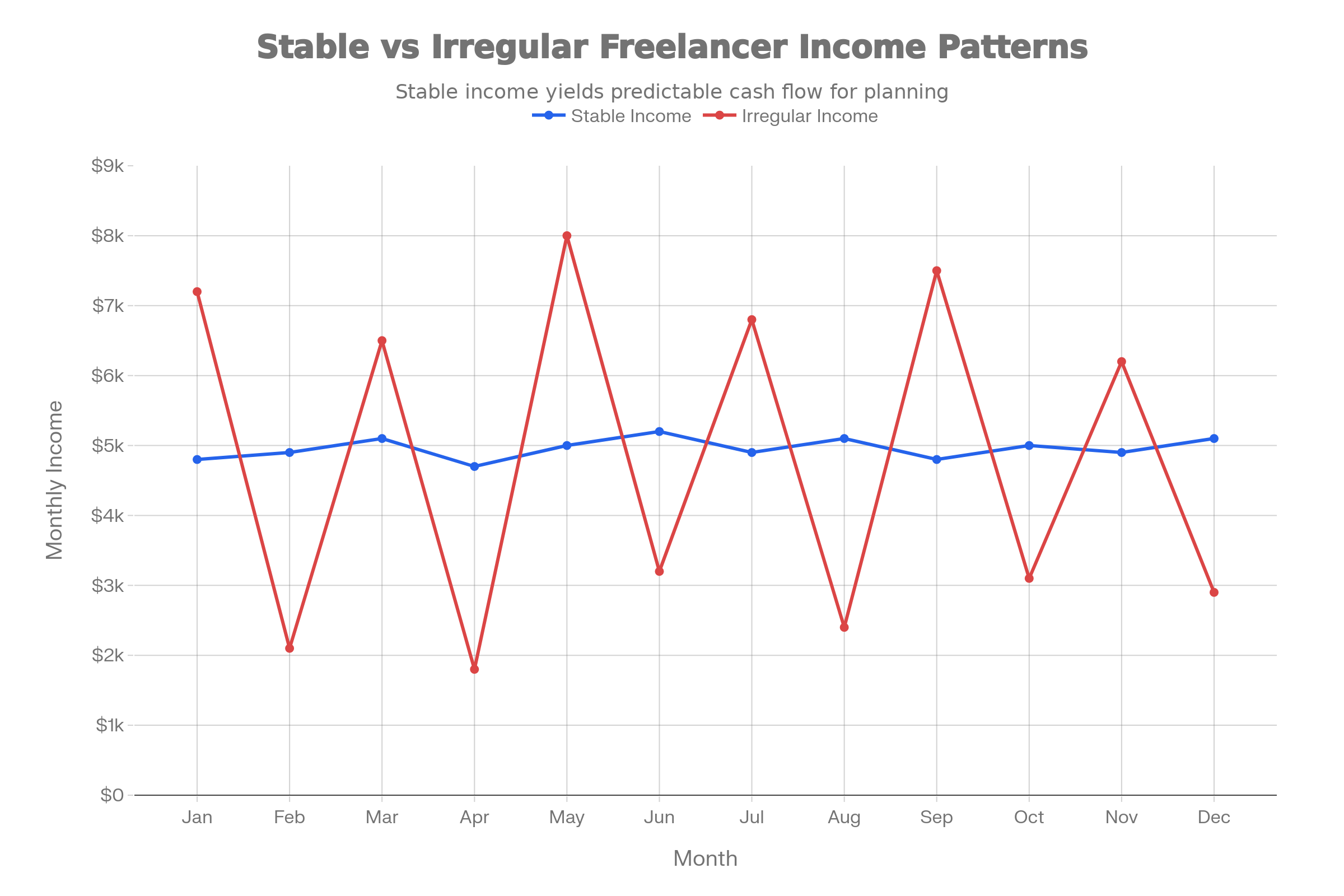
This comparison shows why credit card companies prefer consistent freelancer income over large but unpredictable income swings.
One of the biggest misconceptions among freelancers is that a higher total income will automatically lead to credit card approval. In reality, a freelancer earning $60,000 annually with highly irregular income patterns often faces rejection while another freelancer earning $45,000 with consistent monthly deposits receives approval easily. The difference lies entirely in how income arrives and how stable that arrival pattern is.
Lenders evaluate your income over a 6 to 12-month period to assess stability. If you received $8,000 one month and $1,500 the next, the issuer may calculate a conservative estimate of what you can reliably count on each month, rather than averaging all the months together. This conservative approach protects the card issuer but can disadvantage freelancers whose income naturally fluctuates between seasons or project cycles.
Consider seasonal freelance work like graphic design during holiday seasons or holiday gift-wrapping services. A freelancer who earns heavily during November and December but less during other months will likely show lower approval odds or smaller credit limits than a year-round freelancer with the same annual income. The issuer acknowledges the work exists but factors in that four to six months of the year will have reduced income.
Types of Freelancer Income Credit Card Companies Consider
Not all freelance income is viewed equally. Credit card issuers categorize income types based on how reliably that income can be documented and how stable the source appears to be.
| Income Type | How Issuers View It | Why It Matters |
|---|---|---|
| 1099 Contractor Income | Moderate acceptance | Most common freelance income; requires proof through tax returns and bank statements |
| 1099-K Income (Payment Cards/Network Transactions) | Strong signal | Shows regular client transactions and consistent payment flow patterns |
| Sole Proprietor Income | Moderate acceptance | Requires 2 years of tax returns; self-employment tax status is documented |
| Invoiced Project-Based Work | Weak to moderate | Hard to verify consistency; relies on contract dates and payment history |
| Passive/Royalty Income | Weak signal | Considered secondary income; inconsistent and unpredictable |
| Multi-Client Portfolio Income | Strong signal | Diversification reduces risk; if one client disappears, income remains stable |
| Spouse’s or Partner’s Income | Full acceptance (if documented) | Can be included if co-applicant or if you have reasonable access to funds |
The strongest income signals for freelancers come from documented, recurring revenue sources. If you work with the same clients repeatedly on regular intervals—such as monthly retainers or quarterly projects—that consistency translates directly into issuer confidence. Conversely, irregular project-based work with long gaps between payments appears riskier, even if the total annual revenue is substantial.
How Credit Card Issuers Evaluate Irregular Freelancer Income in Practice
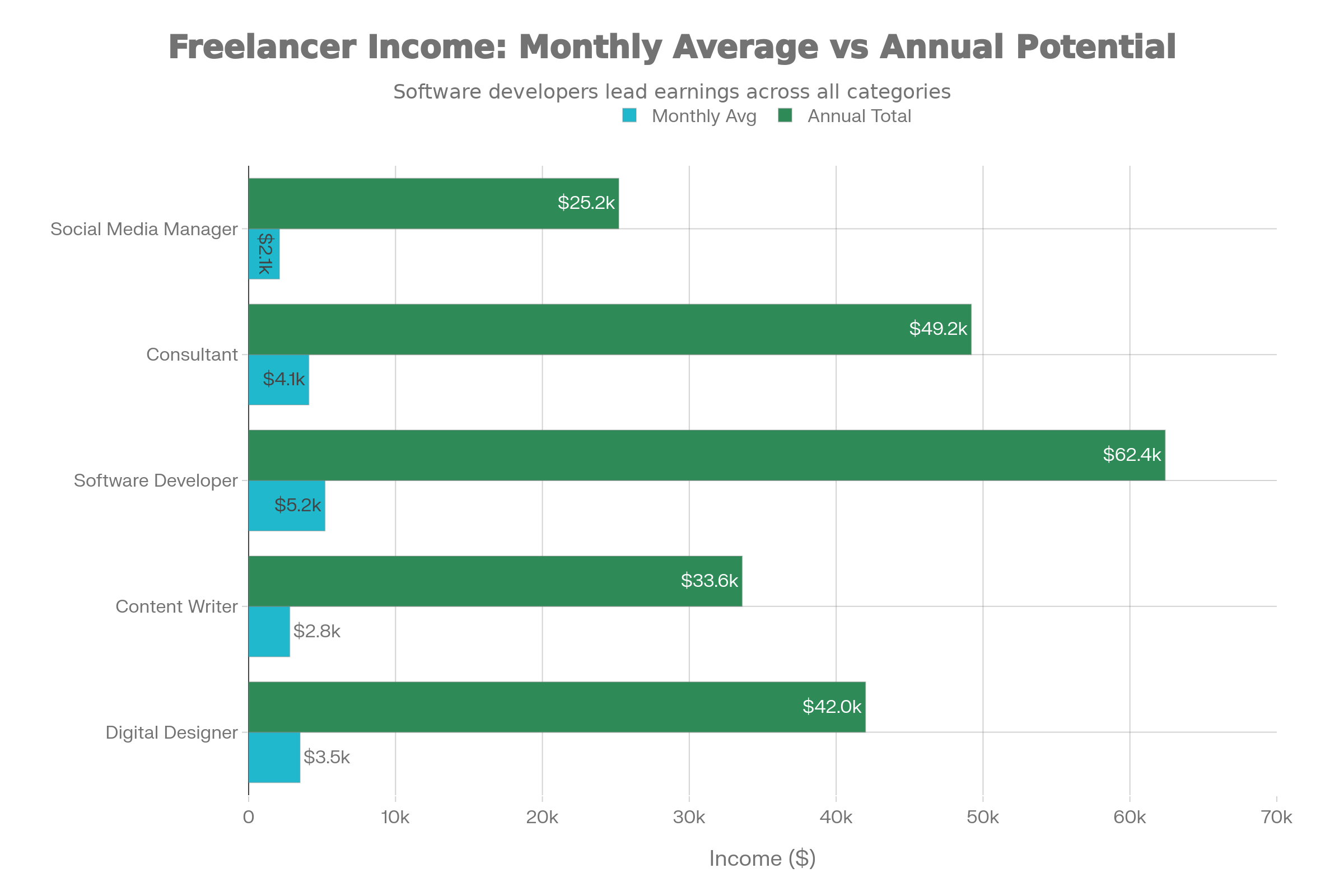
Credit card issuers often focus on reliable monthly income rather than total annual earnings when evaluating freelancers.
The Role of Credit Score and Income Together
Your credit score and reported income don’t work in isolation. Issuers use both in tandem to assess risk. If you have an excellent credit score (750+) with a history of on-time payments and low credit utilization, issuers are more willing to accept stated income without extensive verification, even if that income is irregular.
However, if your credit score is fair (650-749) or lower, the issuer scrutinizes income more carefully. A weak credit score combined with irregular or difficult-to-verify income leads to either denial or a lower credit limit.
Debt-to-Income Ratio Assessment
Issuers also evaluate your debt-to-income (DTI) ratio—the percentage of your gross monthly income that goes toward monthly debt payments. The calculation is straightforward: divide your total monthly debt obligations by your gross monthly income, then multiply by 100.
For example, if your monthly debt payments (car loan, existing credit cards, student loans) total $1,200 and your average freelance income is $4,500, your DTI ratio is 26.7%. Most lenders prefer DTI ratios below 35-36%, making you a favorable applicant. Above 43%, approval becomes challenging.
For freelancers, the challenge is calculating reliable monthly income when that income fluctuates. Conservative underwriters often use a lower estimate—perhaps the average of your lowest-income months—rather than your best months. This protects both you and the issuer from overextending credit during inevitable lean periods.
Income Modeling and Risk Assessment
Modern credit card issuers employ sophisticated risk models that analyze years of lending data to predict default probability. These models consider income stability as one variable among many, including your credit history, payment patterns, spending habits, and the ratio of your new credit request to existing credit.
The model doesn’t require perfect documentation or even perfect income stability. Instead, it assigns a probability to the question: “What’s the likelihood this person will default on this credit card?” If that probability is low, approval happens quickly. If the probability is elevated due to income uncertainty combined with other risk factors, the issuer may deny the application, offer a lower credit limit, or assign a higher interest rate.
Documents That Help Support Freelancer Income
While credit card companies often accept stated income without verification, having documentation available can strengthen your application and may be requested during a financial review (which happens if you apply for multiple cards in a short time, spend heavily, or show other unusual patterns).
Bank Statements (6-12 months)
Your bank statements provide the most direct evidence of actual income received. Regular deposits from clients, consistent payment patterns, and a healthy account balance all signal stability. Issuers use bank statements to verify that stated income aligns with actual deposits.
Income Tax Returns (Last 2 years)
Tax returns serve as official documentation of self-employment income according to the IRS. They’re particularly valuable because they’re filed with the IRS and represent an official record. However, tax returns are often filed after the year ends, making them less current than bank statements. Issuers typically request returns when verifying self-employment income for higher credit limits or mortgages.
Profit and Loss Statements
If you maintain a P&L statement for your freelance business, it provides a documented record of income minus business expenses. This helps clarify your net income—the amount actually available for personal use, as opposed to gross income from clients.
Business Contracts or Service Agreements
Written agreements with long-term clients demonstrate income stability. A contract for ongoing monthly work appears more reliable than a series of one-off projects. While issuers don’t typically request these during initial card applications, they can be valuable if you’re appealing a denial or requesting a credit limit increase.
Important note: For most credit card applications, these documents are helpful but not mandatory. Credit card issuers typically accept stated income without requesting verification unless they conduct a financial review. For mortgage applications, business loans, or credit limit increases, documentation becomes more critical.
Common Mistakes Freelancers Make When Reporting Income
Understanding what credit card companies look for is only half the battle. Many freelancers inadvertently undermine their applications by making predictable errors when reporting income or managing credit.
Overstating Income
The temptation to report higher income is understandable, but it backfires. If your application triggers a financial review and the issuer discovers your stated income doesn’t match tax returns or bank statements, the consequences range from immediate denial to account closure if discovered after approval. The risk isn’t worth the potential higher credit limit.
Mixing Personal and Business Income
If you have multiple income sources—a day job plus freelance work, for example—clearly separate them especially when exploring whether can gig workers get credit cards without proof of income. Report your day job income under employment income and freelance income under self-employment income. This transparency helps issuers understand which income sources are stable versus variable. Commingling income sources creates confusion and may trigger additional verification.
Ignoring Income Patterns
Don’t simply average your income across 12 months and report that number. If you have significant seasonal variation, your average might not reflect your actual monthly availability. For example, if you earn $8,000 during your busy season (June-September) and $2,000 during slow months, reporting an average of $4,167 might be technically accurate but doesn’t reflect what you can reliably spend each month. Be prepared to explain seasonal patterns if asked.
Confusing Gross and Net Income
Gross income is total money received from clients before expenses. Net income is what remains after business expenses (software, equipment, freelance platform fees, internet service). Credit card companies typically want gross income when assessing ability to pay, since they’re evaluating your total financial resources. However, for loan applications, net income is often more relevant. Know which figure you’re reporting and why.
Allowing High Credit Utilization
One of the strongest signals to an issuer that a freelancer is struggling financially is consistently high credit card utilization—carrying balances above 30% of available credit. This suggests you’re relying on credit to cover gaps between paychecks, which looks like financial stress regardless of your stated income.
Real-World Examples of Freelancer Income Evaluation
Example 1: Stable but Moderate Income—Likely Approval
Sarah is a freelance content writer earning an average of $3,800 monthly from four regular clients. Her income ranges from $3,500 to $4,200 per month with minimal variation. Her credit score is 720, and her total monthly debt (student loan and car payment) is $950, giving her a DTI of 25%. She applies for a credit card with a $3,500 annual income requirement.
Expected outcome: Approval at a standard interest rate with a $3,000-$5,000 credit limit. Why? Her stated income is reasonable and corroborated by consistent monthly deposits. Her credit score is good, DTI is healthy, and her income stability suggests she can make monthly payments reliably. The issuer has high confidence in her ability to repay.
Example 2: High but Inconsistent Income—Likely Delay or Denial
Marcus is a freelance consultant earning an annual total of $72,000, but his income varies wildly. Some months he earns $12,000; other months he earns $2,000. His credit score is 680 (fair), and his monthly debt obligations total $1,800. He applies for a credit card and reports annual income of $72,000 (monthly average of $6,000).
Expected outcome: Either denial or assignment of a lower credit limit with higher interest rate. Despite high annual earnings, the issuer views his income as unpredictable. Combined with his fair credit score, the risk profile is elevated. A financial review might be triggered, and Marcus may be asked to provide tax returns or bank statements. Even if approved, his limit would likely reflect his lower-income months rather than his average.
Example 3: Multiple Income Sources with Documentation—Conditional Approval
Jennifer works a part-time job earning $2,200 monthly (W-2 income with verifiable paystubs) plus freelance graphic design work averaging $2,400 monthly. Her combined monthly income is $4,600, her credit score is 745, and her DTI is 30%. She applies for a credit card and clearly reports both income sources.
Expected outcome: Approval at a standard interest rate with a credit limit of $4,000-$6,000. Her W-2 income provides stability, and her freelance income is secondary but meaningful. By reporting both, she demonstrates financial diversification. The issuer feels confident she has reliable income (the job) with additional upside from freelance work.
Conclusion
The process of how credit card companies evaluate freelancer income might seem mysterious, but it’s fundamentally rooted in a single principle: predictability drives creditworthiness. Credit card issuers don’t care whether you’re salaried or self-employed. They care about whether you’ve demonstrated the ability to reliably receive income each month and manage existing financial obligations. The fact that your income doesn’t follow traditional salary patterns doesn’t disqualify you—it just means you need to present your financial situation clearly and understand how issuers interpret income stability.
Most freelancers can qualify for credit card approval for 1099 income, and many receive approval without extensive documentation. The key is maintaining consistent monthly income patterns when possible, keeping your credit score strong, managing your debt-to-income ratio carefully, and avoiding the temptation to overstate earnings. If your income is genuinely irregular, be transparent about it rather than trying to hide the variation. Documentation like bank statements and tax returns, while often not required for credit card approval, can be powerful supporting evidence if you’re asked to verify your income or if you’re appealing a denial.
Understanding how credit card companies evaluate freelancer income empowers you to present your financial situation in the strongest possible light, positioning yourself for approval and favorable terms.
Frequently Asked Questions
Do credit card companies actually verify the income I report?
Most credit card companies accept your stated income without direct verification for initial applications. They use a process called income modeling, which analyzes your credit report and financial patterns to assess whether your stated income is plausible. However, if you apply for multiple cards in a short time, request a high credit limit, or spend heavily, the issuer may conduct a financial review, which does require documentation.
How does seasonal income affect my credit card application?
Seasonal income is viewed as a risk factor because it means you won’t have consistent income every month. Issuers typically use a conservative estimate based on your lower-income months rather than your average or highest months. If you have a contract that guarantees year-round work or multiple clients across different seasons, that diversification helps. Document seasonal patterns clearly in your application rather than trying to hide them.
What income should I report if I have multiple freelance clients?
Report the total income from all freelance sources. You can organize it as “self-employment income” and provide a breakdown if asked. What matters to the issuer is the total monthly or annual amount you reliably earn across all your freelance work. If income from individual clients varies but the total remains stable, that’s a positive signal.
Can I include my spouse’s income on my application?
Yes, if you have a reasonable expectation of access to that income (for example, you’re married or have a legal partnership). You’ll typically need to provide documentation such as their pay stubs or tax returns. However, the spouse must also meet the issuer’s creditworthiness requirements if they’re listed as a co-applicant. Including household income can strengthen your application if your personal freelance income alone is modest.
How is income calculated when freelancers like me get paid irregularly?
Credit card companies that evaluate freelancer income typically calculate it by averaging monthly deposits over the past 6-12 months or by identifying a sustainable monthly amount based on documented earnings history. They may use a conservative approach that averages lower-income months more heavily than peak months. The goal is determining what you can reliably expect to receive each month, not what you hope to earn.
What if I have a high income but poor credit score?
High income alone doesn’t guarantee approval if your credit score is low. Credit score reflects your payment history and credit management behavior, while income reflects ability to pay. Together, they create your risk profile. A low credit score combined with high income suggests you’ve struggled to manage credit in the past, which raises concerns even if you have the income to make payments. Improving your credit score before applying for a new card strengthens your approval odds.
How long do I need to be self-employed before credit card companies take my income seriously?
Most issuers expect to see at least 2 years of self-employment history documented in tax returns. However, many credit cards accept stated income for first-time applicants without this requirement, relying instead on your credit score and other factors. If you’re newly self-employed, your best strategy is applying with a good credit score and being prepared to explain your background. You might also consider starting with a smaller credit limit request.
Disclaimer: This article is for educational purposes only and does not constitute financial, legal, or professional advice. Credit card issuer policies and evaluation criteria may vary.