
Why This Question Matters to 1099 Earners
Credit cards for freelancers can be difficult to get when income documentation is irregular or unavailable.If you’re a freelancer reading credit card eligibility requirements, you’ve probably hit the same wall: “proof of income required.” For designers billing clients through PayPal, writers juggling three platforms, developers working contract-to-contract, or consultants whose income varies month to month, that phrase can feel like a locked door.
The confusion is understandable. You earn money—sometimes good money—but you don’t have W-2s or pay stubs. Your income doesn’t arrive on the 1st and 15th like clockwork. Some months are feast, others are famine. And when a credit card application asks you to state your annual income, you’re left wondering: Will they believe me? Will they ask for proof? And what happens if I can’t provide traditional documents?
This confusion has real consequences. Some freelancers avoid applying altogether, assuming they’ll be rejected. Others overstate their income, not realizing the legal risks. Still others underreport out of caution, inadvertently limiting their approval chances or credit limits.
This article cuts through the confusion with factual, research-backed answers. It will not promise you approval—no one can. But it will explain exactly how credit card companies evaluate freelance income, when verification actually happens, what banks consider “proof,” and how you can apply strategically and legally. By the end, you’ll understand the process well enough to make informed decisions, not anxious guesses.
On This Page
- Why This Question Matters to 1099 Earners
- What Banks Mean by “Proof of Income” for Freelancers
- How Credit Card Companies Evaluate Freelance Income
- Do Banks Always Ask Freelancers for Income Documents?
- Can Freelancers Be Approved Without Submitting Proof of Income?
- The Role of Credit Score and Credit History for Freelancers
- Debt-to-Income Ratio Explained for Freelancers
- Legal and Ethical Considerations When Reporting Income
- Common Mistakes Freelancers Make When Applying
- Practical and Legal Ways Freelancers Can Improve Approval Chances
- Conclusion: Understanding the Process Is More Important Than Chasing Approval
- Frequently Asked Questions
What Banks Mean by “Proof of Income” for Freelancers
When a credit card application asks for “proof of income,” the phrase means different things depending on context. For traditional employees, proof is straightforward: a pay stub showing gross income, employer name, and year-to-date earnings. Banks trust this because the income is predictable and verifiable through third parties.
For freelancers and 1099 earners, “proof” is messier. There’s no employer to call. There’s no biweekly deposit hitting your account like clockwork. Your income might come from five different clients, or fifty. Some pay you via check, others through Venmo or direct deposit. The result is that banks must rely on alternative documentation—or, in many cases, they rely on your word alone.
The distinction between stated income and verified income is critical here. Stated income is what you declare on the application form. Most credit card issuers use this figure without asking for supporting documents during the initial approval process. They assess your creditworthiness primarily through your credit score, existing debt load, and payment history—not by demanding tax returns upfront.
Verified income, by contrast, is income that you’ve proven through documentation such as tax returns, bank statements, or 1099 forms. Verification typically happens in specific situations: when you request a large credit limit increase, when your spending patterns trigger a risk review, or when the bank conducts a random financial audit. For most freelancers applying for a standard credit card with a modest limit, verification doesn’t occur unless something raises a red flag.
This doesn’t mean you can fabricate numbers. Credit bureaus like Experian now use income estimation algorithms that can predict your earnings to within a few thousand dollars based on your credit profile, spending history, and demographic data. If your stated income is wildly inconsistent with your financial behavior—say, you claim $150,000 annually but only charge $300 a month across all your cards—the system may flag your application for review.
How Credit Card Companies Evaluate Freelance Income
Credit card issuers are required by federal law to assess your ability to pay before issuing a card or increasing your credit limit. This requirement stems from the Credit Card Accountability Responsibility and Disclosure (CARD) Act of 2009. The law mandates that issuers consider your income or assets and your current debt obligations when making lending decisions. To understand the process better, it helps to know how credit card approval works for 1099 income and why freelance earnings are evaluated differently.
However, the CARD Act does not require issuers to verify your income in every case. It only requires them to consider it. In practice, this means that credit card companies have developed policies and procedures that allow them to assess ability to pay without demanding documentation from every applicant. For freelancers, this is good news.
When you apply for a credit card as a freelancer, the issuer evaluates several factors simultaneously. Your credit score is the most heavily weighted variable. A score of 670 or higher signals to the bank that you have a history of managing debt responsibly. This matters far more than your job title or income source. A freelance graphic designer earning $50,000 with a 750 credit score is more likely to be approved than a salaried employee earning $80,000 with a 620 score.
Your credit history length also plays a significant role. Issuers want to see that you’ve successfully managed credit accounts over time—ideally two years or more. If you’re new to credit, your approval odds drop, regardless of income.
Credit utilization ratio—the percentage of available credit you’re currently using—is another key metric. Keeping this ratio below 30% signals financial discipline. If you’re maxing out existing cards each month, even with on-time payments, issuers may view you as overextended.
Only after these factors are assessed does stated income come into play. And even then, it’s often evaluated in relation to your other financial indicators rather than taken at face value. If your income claim seems consistent with your spending patterns, account balances, and credit limits on existing cards, most issuers will approve your application without further inquiry.
Freelance income is inherently less predictable than W-2 income, and banks know this. They account for variability by looking for patterns rather than fixed amounts. A consultant who earned $45,000 one year and $60,000 the next isn’t necessarily seen as risky—provided their credit behavior remains stable. What concerns issuers more is unmanageable debt relative to income, not the freelance structure itself.
Do Banks Always Ask Freelancers for Income Documents?
No. In fact, most credit card applications for freelancers are approved based on stated income alone, with no upfront request for tax returns, bank statements, or 1099 forms.
This surprises many applicants, but it’s the industry standard for several reasons. First, requesting and reviewing income documents is expensive and time-consuming for issuers. For lower credit limits—say, $1,000 to $5,000—the cost of verification often exceeds the risk of potential default. Second, credit scores and credit history have proven to be strong predictors of repayment behavior, often more reliable than income figures. A freelancer with a 720 score and five years of clean payment history is statistically less risky than a salaried employee with a 650 score and recent late payments.
That said, income verification can and does happen. The circumstances under which banks request documentation fall into a few predictable categories:
Credit limit increase requests. When you ask to raise your limit significantly—especially beyond $25,000 with certain issuers like American Express—you may trigger a financial review. The bank will request tax returns, W-2s, or other proof of income to justify the higher exposure. This is particularly common if your request represents a large jump from your current limit.
Risky spending behavior. If you suddenly charge large amounts shortly after opening an account, or if you apply for multiple credit cards within a short window, issuers may initiate a manual review. During this process, they may ask you to verify your income to ensure you can manage the debt load.
Random audits. Some issuers, notably Discover and American Express, are known to conduct periodic financial reviews on a subset of cardholders. These reviews are not triggered by specific behavior; they’re part of the issuer’s risk management process. If you’re selected, you’ll be asked to provide documentation. Failure to comply typically results in account closure or credit limit reduction.
Large discrepancies. If the income you stated on your application is dramatically inconsistent with your spending patterns, reported income on previous applications, or estimated income from credit bureau algorithms, the bank may flag your file for verification. For example, if you claimed $120,000 in annual income but your credit report shows $30,000 in annual income from a prior mortgage application, expect questions.
For freelancers applying for their first credit card or a modest-limit card with a solid credit score, the likelihood of verification during initial approval is low. Most issuers process these applications through automated underwriting systems that rely primarily on credit data, not income proof
Can Freelancers Be Approved Without Submitting Proof of Income?
Yes—and it happens regularly. Freelancers are approved for credit cards every day without providing a single tax return, bank statement, or 1099 form. However, approval is not guaranteed, and it depends on several factors working in your favor.
Credit score is the single most important variable. If you have a good to excellent score—generally 670 or above, though 700+ is preferable—you’re far more likely to be approved without income verification. The score demonstrates that you’ve managed debt responsibly in the past, which banks value more than income level alone.
Credit history depth matters. Even with a good score, a thin credit file—meaning few accounts or a short credit history—can reduce your approval odds. Banks prefer to see at least two years of credit history and multiple account types (e.g., a credit card and an installment loan) before they feel confident extending credit to a self-employed applicant.
Reasonable stated income. When you fill out the application, the income figure you provide should be plausible given your age, location, credit profile, and spending history. If you’re 24 years old and claim $200,000 in annual income, that’s likely to raise flags unless your credit file supports such earnings (e.g., high credit limits, large monthly payments, etc.). Conversely, underreporting your income—out of caution or confusion—can hurt you by limiting your credit limit or approval chances.
Low credit utilization on existing accounts. If you already have credit cards and you’re using less than 30% of your available credit, that signals financial stability. It tells the issuer you’re not desperate for credit and that you manage your finances well.
No recent negative marks. Late payments, collections, charge-offs, or bankruptcies in the past two years will severely damage your approval odds, regardless of your current income. Even a single 30-day late payment can tip the scales toward denial for applicants with borderline credit profiles.
When these factors align, many freelancers are approved for credit cards with limits ranging from $1,000 to $10,000 without ever being asked to verify their income. The issuer runs a credit check, evaluates the stated income in relation to the applicant’s overall financial picture, and issues a decision—often within minutes.
That said, approval limits are often lower for freelancers than for salaried employees with comparable credit scores. This is a risk management strategy. Banks may approve your application but cap your initial limit at $2,000 or $3,000, even if your income would justify more. Over time, as you use the card responsibly and your relationship with the issuer strengthens, you can request limit increases—at which point verification may become more likely.
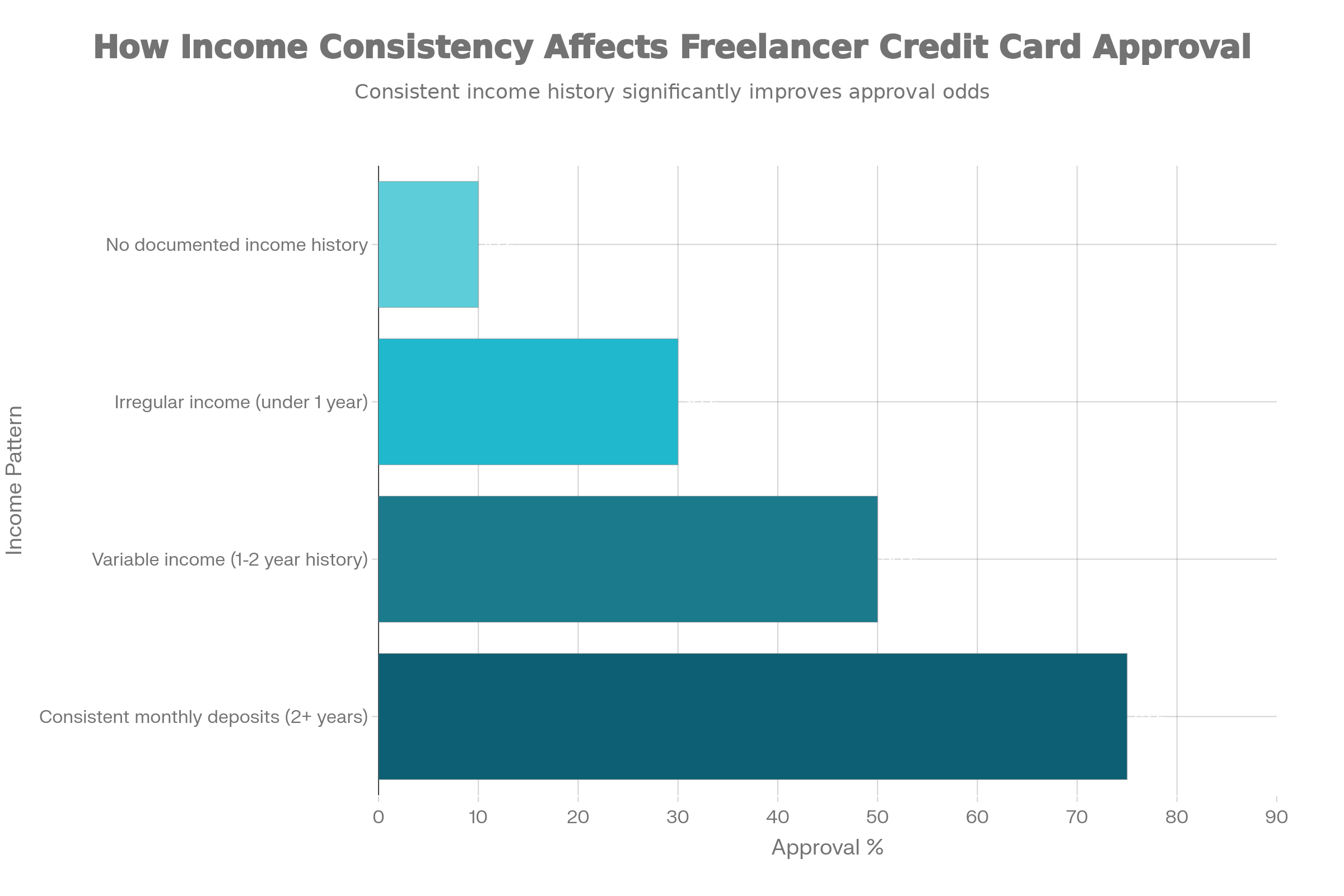
Freelancers with consistent documented income over 2+ years have significantly higher approval odds compared to those with irregular or undocumented income patterns
The Role of Credit Score and Credit History for Freelancers
Credit score is the gatekeeper. If your score is below 670, approval for most unsecured credit cards becomes difficult, regardless of how much you earn. For freelancers, this reality is even more pronounced because banks already perceive self-employment as higher risk due to income variability. A strong credit score counterbalances that perception.
Why credit score matters more than income
Credit scores are built on payment history, amounts owed, length of credit history, new credit, and credit mix. These factors collectively predict your likelihood of repaying debt. Income, by contrast, is only one indicator of ability to pay—and for freelancers, it’s a volatile one. A consultant might earn $80,000 one year and $40,000 the next. But if that consultant has never missed a payment in five years, their credit score reflects that consistency. Banks trust the score more than the income figure.
Most business credit cards for freelancers require a minimum score of around 670, with 700+ being the sweet spot for better approval odds and higher initial limits. Premium cards—those offering substantial rewards or perks—often require scores of 750 or higher.
Credit history length.
Even if your score is strong, a short credit history can limit your options. Lenders prefer to see at least two years of credit activity, ideally with multiple account types. If you’re new to credit, consider starting with a secured credit card (which requires a deposit) or becoming an authorized user on a family member’s account to build history before applying for an unsecured card on your own.
Payment history is non-negotiable.
Payment history accounts for roughly 35% of your FICO score, making it the most influential component. A single late payment in the past 12 months can reduce your score by 50 to 100 points, depending on your overall profile. For freelancers, who may already face skepticism about income stability, a blemished payment record is often disqualifying.
Existing credit relationships.
If you already have a credit card or loan with a particular bank, applying for another card with that same issuer can improve your approval odds. The bank has data on your payment behavior and account management, which reduces their uncertainty. This is particularly helpful for freelancers who may not have traditional income documentation but can demonstrate reliability through existing accounts.
Debt-to-Income Ratio Explained for Freelancers
Debt-to-income ratio (DTI) measures your monthly debt obligations relative to your monthly income. For example, if you earn $5,000 per month and pay $2,000 toward debts (student loans, car payments, credit card minimums, etc.), your DTI is 40%.
Credit card issuers are required to consider your ability to pay under the CARD Act, and DTI is one way they assess this. However, DTI is more strictly applied in mortgage lending than in credit card underwriting. For credit cards, issuers often focus on your credit score and utilization ratio rather than calculating a precise DTI.
That said, if your stated income is low relative to your existing debt obligations, approval becomes harder. Most lenders prefer to see DTI below 43% to 50%. Above that threshold, they worry you won’t have enough cash flow to manage additional credit card payments.
For freelancers, DTI calculations are complicated by income variability. If your income fluctuates, how should you calculate the “income” side of the equation? The general approach is to use an average over the past 12 to 24 months, based on tax returns or bank deposits. This smooths out the peaks and valleys and gives a more realistic picture of your financial capacity.
High DTI is particularly problematic for freelancers because it signals overextension. If you already have $1,500 in monthly debt payments and your average monthly income is $3,000, adding a new credit card increases your risk of missing payments during slow months. Banks account for this by either denying the application or approving it with a lower credit limit.
If your DTI is high, focus on paying down existing debt before applying for new credit. Even reducing your DTI by 10 percentage points—say, from 50% to 40%—can significantly improve your approval odds.
Legal and Ethical Considerations When Reporting Income
When you sign a credit card application, you’re certifying that the information you’ve provided is accurate. Knowingly misrepresenting your income is fraud, and while prosecution is rare for minor overstatements, the consequences can be severe. Credit card issuers are required to assess a consumer’s ability to pay under U.S. federal law, as explained by the Consumer Financial Protection Bureau.
Federal law treats credit application fraud seriously.
Under 18 U.S.C. § 1014, providing false statements on a credit application can result in fines up to $1 million and imprisonment up to 30 years. These are extreme penalties reserved for egregious cases—someone who claims $200,000 in income when they earn $20,000, defaults on the debt, and then files bankruptcy, for example. But the law exists, and it applies to credit card applications.
More realistic consequences.
In practice, if a bank discovers you’ve significantly overstated your income, the most likely outcomes are account closure, credit limit reduction, and forfeiture of rewards. If you default on the card, the issuer may pursue collection or legal action, and your fraudulent application can be used as evidence that you never intended to repay the debt. In bankruptcy proceedings, debts obtained through fraud are often non-dischargeable, meaning you remain liable even after bankruptcy.
When minor overstatements become problems.
If you stated $60,000 in income but actually earn $55,000, most issuers won’t care—particularly if you’re managing the account responsibly. The trouble arises when the discrepancy is large or when you default. If you claimed $100,000 but earn $30,000, and you max out the card and stop paying, the bank may investigate. They can request your tax returns, compare them to your application, and use the discrepancy to pursue legal remedies.
Verification triggers.
Even if you don’t default, certain behaviors can prompt income verification. Applying for a large credit limit increase, requesting multiple cards in a short period, or spending heavily soon after account opening can all trigger financial reviews. During these reviews, you’ll be asked to provide documentation. If you can’t substantiate your stated income, the bank may close your account or reduce your limit.
The honest approach.
The safest and most straightforward strategy is to report your income truthfully. If you’re a freelancer with variable income, calculate an average based on your last two years of earnings, including all verifiable sources: 1099 income, consulting fees, business revenue, rental income, investment income, etc.. You’re allowed to include any income to which you have “reasonable access” if you’re over 21, which can include a spouse’s income in some cases. Be conservative, but don’t underreport out of fear. A slightly lower stated income won’t disqualify you if your credit score is strong.
Common Mistakes Freelancers Make When Applying
Overestimating income dramatically.
Some freelancers, eager to maximize their approval odds or credit limit, inflate their income figures beyond what they can document. This creates risk. If the bank ever requests verification—during a credit limit increase, a financial review, or a collections process—you won’t be able to support the number you provided. The better approach: use a realistic average from your past two years of tax returns.
Applying for multiple cards in a short window.
Each credit card application generates a hard inquiry on your credit report, which can lower your score by a few points. More importantly, applying for several cards within a few months signals financial distress to underwriters. They interpret it as a sign that you’re scrambling for credit, which increases perceived risk. The general recommendation is to wait at least six months between applications
Applying too early in your credit journey.
If you have no credit history or a very thin file, applying for premium rewards cards or business cards is likely to result in denial. Start with a secured credit card or a student card if you’re eligible. Build at least 12 to 24 months of clean payment history before applying for unsecured cards with better terms.
Ignoring credit utilization.
Freelancers who use credit cards heavily for business expenses sometimes carry high balances, even if they pay them off eventually. High utilization—especially above 30%—can hurt your credit score and reduce approval odds for new cards. If possible, pay down balances before applying, or make multiple payments per month to keep reported utilization low.
Failing to organize financial records.
Even though most applications don’t require upfront documentation, you should have your records ready in case verification is requested. Keep at least two years of tax returns, recent bank statements showing regular deposits, and any 1099 forms you’ve received. If you can’t produce these documents when asked, you risk account closure or denial of a limit increase.
Mixing business and personal finances.
This doesn’t directly impact credit card approval, but it complicates income documentation. If your business revenue and personal income are intermingled in a single checking account, separating them for verification purposes becomes difficult. Consider opening a separate business account to make your financial picture clearer to both yourself and potential lenders.
Practical and Legal Ways Freelancers Can Improve Approval Chances
Build credit before applying. If you’re new to credit or have a low score, your first step should be building or rebuilding your credit history. Options include becoming an authorized user on a family member’s card, applying for a secured credit card, or taking out a credit-builder loan. Each of these strategies helps establish a payment history and increase your credit score over time.
Start with a secured credit card. Secured cards require a cash deposit—typically $200 to $2,000—which serves as your credit limit. Because the deposit reduces the issuer’s risk, approval is much easier, even for freelancers with no credit history or low scores. After 12 to 18 months of on-time payments, many issuers will convert your secured card to an unsecured card and refund your deposit.americanexpress+2
Keep financial records organized. Even if you don’t need them upfront, having clean, accessible records positions you to respond quickly if verification is requested. Maintain digital copies of your tax returns (especially Schedule C if you file as a sole proprietor), bank statements showing consistent deposits, and invoices or contracts from clients. If you’re ever asked to verify income, you’ll be able to respond within days rather than weeks.
Apply strategically, not emotionally. Don’t apply for a credit card on impulse or because you saw an attractive bonus offer. Research the card’s typical approval requirements—some issuers publish minimum credit score ranges or income expectations. Check whether you meet those benchmarks before applying. If you’re borderline, wait a few months, improve your credit profile, and then apply.
Time your applications. Wait at least six months between credit card applications to avoid multiple hard inquiries clustering on your report. If you’re planning a major purchase or travel, apply a few months in advance to give yourself time to meet any spending requirements for sign-up bonuses without financial strain.
Consider business credit cards. Many freelancers assume business credit cards require an LLC or formal business structure. They don’t. You can apply as a sole proprietor using your Social Security number. Business cards often come with higher credit limits, better expense tracking tools, and rewards tailored to business spending. Approval criteria are similar to personal cards: good credit score, reasonable stated income, and clean payment history.
Build relationships with banks. If you already have a checking or savings account with a particular bank, applying for a credit card with that same institution can improve your approval odds. The bank has visibility into your account balances and transaction patterns, which provides them with additional confidence in your financial stability—especially helpful if your stated income is on the lower end.
Keep credit utilization below 30%. Before applying for a new card, pay down existing balances to reduce your utilization ratio. This signals to lenders that you’re not financially stretched and that you can handle additional credit responsibly.
Table 1: W-2 Employees vs Freelancers (1099) – Income & Approval Comparison
| Factor | W-2 Employee | Freelancer (1099) |
|---|---|---|
| Income documentation | Pay stubs, W-2 forms | Tax returns (Schedule C), bank statements, 1099 forms |
| Income predictability | Fixed, biweekly/monthly | Variable, project-based |
| Approval difficulty | Easier | Moderate to difficult (depending on credit score) |
| Verification frequency | Rarely required for standard cards | Sometimes required for higher limits or flagged applications |
| Income sources counted | Salary, bonuses | Freelance fees, consulting income, 1099 income, business revenue, rental income, investment income |
| Typical stated income approach | Exact annual salary | Average over past 1-2 years |
Table 2: Factors Banks Consider Most for Freelance Applicants
| Factor | Weight | Why It Matters | How to Improve |
|---|---|---|---|
| Credit score | Very High | Predicts repayment behavior; freelancers with 700+ scores are viewed as lower risk. | Pay all bills on time, keep utilization low, avoid new inquiries |
| Credit history length | High | Longer history (2+ years) demonstrates stability. | Become authorized user; keep old accounts open |
| Credit utilization ratio | High | Ratios above 30% signal financial stress. | Pay down balances; make multiple payments per month |
| Payment history | Very High | Late payments in past 12 months are disqualifying for many issuers. | Set up autopay; never miss due dates |
| Stated income | Moderate | Used to assess ability to pay, but often not verified. | Report honestly; include all income sources |
| Debt-to-income ratio | Moderate | High DTI (>50%) suggests overextension. | Pay down existing debts before applying |
| Existing bank relationship | Low to Moderate | Prior account history with issuer can improve odds. | Open checking/savings account before applying |
Table 3: Common Freelance Income Sources and How Banks View Them
| Income Source | How Banks View It | Documentation Typically Accepted | Notes |
|---|---|---|---|
| 1099-NEC contract work | Positive—verifiable through tax filings | Tax returns (Schedule C), 1099-NEC forms | Most straightforward for freelancers |
| Cash payments from clients | Neutral to skeptical—harder to verify | Bank statements showing regular cash deposits | Document deposits consistently |
| Consulting fees (invoiced) | Positive—demonstrates business structure | Invoices, contracts, bank statements | Keep detailed records |
| Platform income (Upwork, Fiverr, etc.) | Positive—platform reports are credible | Platform earnings statements, 1099-K if >$20K | Easy to document |
| Royalties or residual income | Positive—viewed as passive income | 1099-MISC, royalty statements | Stable and predictable |
| Business revenue (sole proprietor) | Positive—if consistent over 2+ years | Schedule C from tax returns, profit/loss statements | Banks prefer 2-year history |
| Rental income | Positive—passive and verifiable | Lease agreements, 1099-MISC, bank deposits | Include in stated income |
| Investment income | Positive—signals financial stability | 1099-DIV, 1099-INT, brokerage statements | Can supplement freelance income |
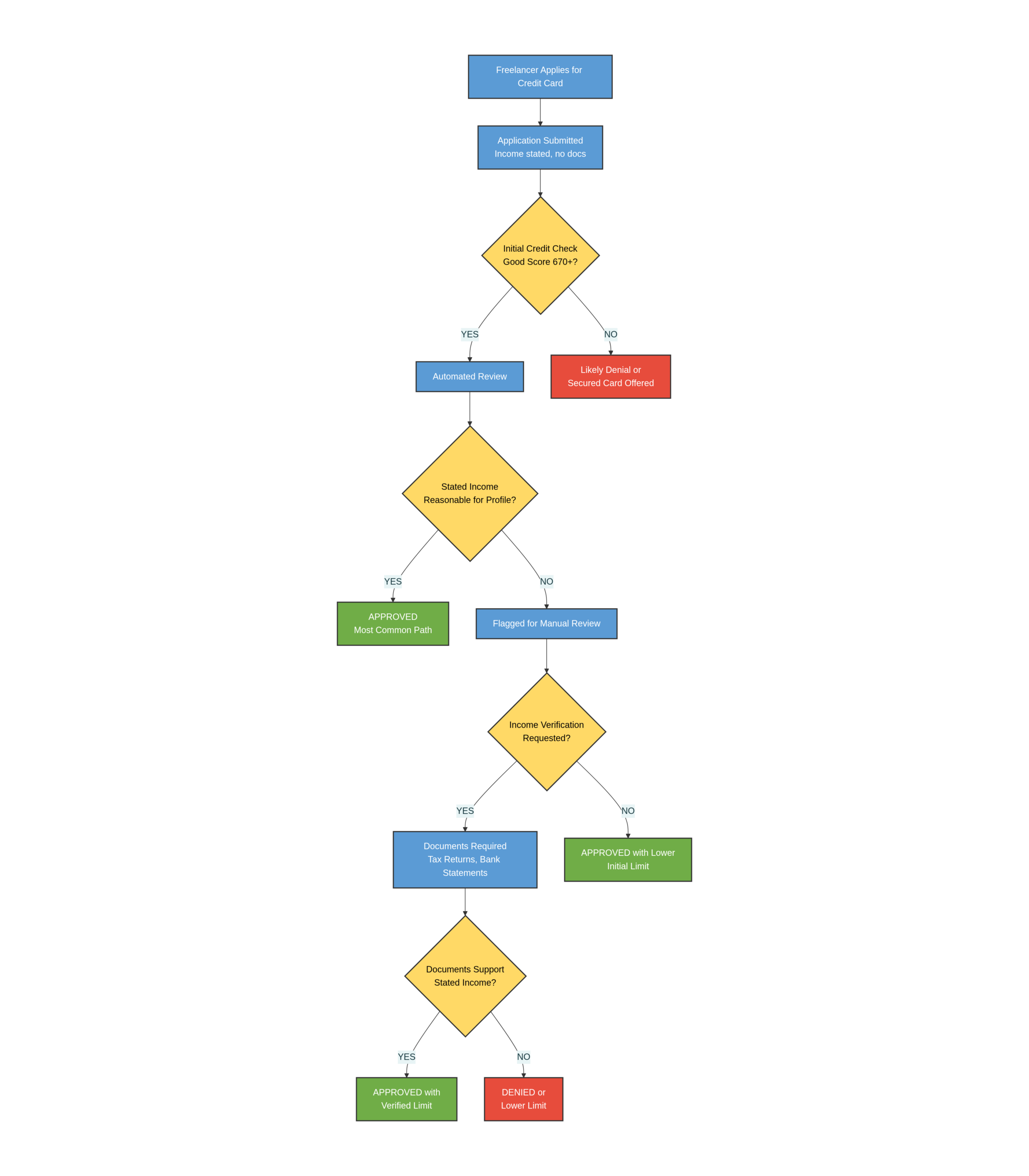
The credit card approval process for freelancers typically begins with stated income and automated credit checks, with income verification requested only in specific circumstances
Conclusion: Understanding the Process Is More Important Than Chasing Approval
Credit card approval for freelancers is not a mystery—it’s a system. That system prioritizes credit score and payment history over income level, relies on stated income more often than verified income, and evaluates ability to pay through algorithms and credit data rather than pay stubs and W-2s.
This means you don’t need perfect documentation or a salary to get a credit card. You need a solid credit score, a reasonable income figure that aligns with your financial behavior, and a clean payment history. If those elements are in place, approval is likely—even without submitting a single document.
But understanding the process also means recognizing when you’re not ready. If your credit score is below 670, if you have recent late payments, or if your debt load is already high relative to your income, applying now will likely result in denial—and a hard inquiry that temporarily lowers your score. In those cases, the smarter move is to spend six months improving your credit profile before you apply.
For freelancers, the path to credit isn’t about gaming the system or exaggerating income. It’s about building a financial foundation—paying bills on time, keeping debt manageable, and demonstrating consistency even when your income isn’t perfectly consistent. When you do that, banks see you as creditworthy, regardless of whether your income arrives on a 1099 or a W-2.
Frequently Asked Questions
Q: Can I get a credit card as a freelancer if I don’t have tax returns yet?
Yes, but it’s more challenging. If you’ve been freelancing for less than a year and haven’t filed taxes, you’ll likely need to rely on your credit score and bank statements showing income deposits. Consider applying for a secured credit card first, which doesn’t require income verification. After you file your first tax return, you’ll have stronger documentation for future applications.
Q: What income can I legally include on my credit card application as a freelancer?
You can include any income to which you have reasonable access. This encompasses freelance earnings, 1099 contract work, consulting fees, business revenue, rental income, investment income (dividends, interest), and—if you’re over 21—household income such as a spouse’s earnings. Calculate an average based on your past 12 to 24 months if your income varies.
Q: Do credit card companies actually check my income when I apply?
Most of the time, no. Credit card issuers typically use “stated income,” meaning they accept the figure you provide without requesting documentation during initial approval. However, they may verify income later if you request a large credit limit increase, if your spending triggers a financial review, or if they conduct a random audit. Some issuers like Discover and American Express are more likely to request proof of income than others.
Q: What happens if I overstate my income on a credit card application?
If the overstatement is minor (e.g., $60,000 vs. $55,000), it’s unlikely to cause problems as long as you manage the account responsibly. However, significant misrepresentation is fraud and can result in account closure, credit limit reduction, loss of rewards, or legal consequences if you default. In extreme cases, fraudulent applications can lead to fines and criminal charges, though this is rare. The safest approach is always honesty.
Q: Should I apply for a personal credit card or a business credit card as a freelancer?
Either can work. Personal credit cards are fine if you’re keeping business and personal expenses separate through accounting software or discipline. Business credit cards offer advantages like higher limits, expense tracking tools, and rewards tailored to business spending. Importantly, you don’t need an LLC to get a business card—you can apply as a sole proprietor using your Social Security number. If your freelance work is substantial and you want to build business credit, a business card is often the better choice.
Disclaimer: This article is for informational purposes only and does not constitute financial or legal advice. Credit card approval decisions vary by issuer and individual financial circumstances. Readers should review official issuer terms or consult a qualified professional before making financial decisions.