
Introduction
Bank statements vs tax returns credit card approval decisions depend on how lenders verify your income and assess your ability to repay.
When you apply for a new credit card, it is easy to focus only on your credit score and ignore the income box on the application. Your credit score describes how you have handled debt in the past, but your income tells a lender whether you can realistically handle more debt right now. Lenders look at your earnings to decide how high a credit limit you can manage without overextending yourself, and in some cases, whether they will approve you at all.
That is where the confusion around documents starts. Many people assume that a single pay stub or a rough income estimate is enough, while others worry they must always submit full tax returns. Self‑employed workers, freelancers, and gig workers often wonder whether bank statements will help more than tax returns, or vice versa. The reality is that both documents can matter, and lenders may weigh them differently depending on your situation. Bank statements vs tax returns credit card approval decisions can vary depending on income consistency and documentation clarity.
Understanding how income verification works, and how bank statements and tax returns fit into that process, can make your credit card applications smoother and more successful. If you’re new to credit cards, it can also help to understand the basics before focusing on approval, which you can learn in our guide on How Credit Cards Work In US — Complete Beginner’s Guide (2026)
Why Lenders Verify Income
From a lender’s point of view, every credit card approval is a risk decision. They already use your credit report to see how reliably you have paid other accounts, but they still need to answer a separate question: “Given this person’s income, is this new line of credit reasonable?”
Income verification helps them evaluate three main ideas: risk, repayment ability, and income stability. Even if you have an excellent credit score, a lender may be cautious if your reported income is low relative to the credit line you are requesting, or if your income looks highly inconsistent over time.
In practice, lenders use income checks to look at:
- monthly disposable income
- debt vs income comparison
- consistency of earnings
Monthly disposable income is what is left after your essential bills, housing, and existing debt payments. A higher cushion gives a lender confidence that you can handle card payments even if your expenses fluctuate.
Debt vs income comparison is similar to a “debt‑to‑income” view: they look at how much you owe on loans and other cards relative to what you earn. If your debts already take up most of your income, adding another line of credit may be viewed as too risky.
Consistency of earnings matters because a predictable income stream reduces the chance that you will miss payments in a slow month. Someone who earns less but has steady, long‑term income can sometimes look safer than someone with high but erratic earnings. Understanding how lenders evaluate income can help applicants prepare better documentation. To better understand how lenders verify income, you can refer to official financial education resources like Consumer Financial Protection Bureau. Lenders often evaluate income stability and repayment ability using general credit guidelines explained in resources like Federal Reserve consumer credit information.
Bank Statements Explained
Bank statements are snapshots of activity flowing through your checking or savings accounts over a period of time—often 30, 60, or 90 days. They show deposits, withdrawals, transfers, and balances, giving lenders a near‑real‑time look at your cash flow. Lenders may request bank statements to confirm that the income you listed on your application is actually landing in your account and to see how regularly it arrives.
For people who are paid by direct deposit, bank statements can show a clear pattern: the same employer name, around the same date each month, and similar amounts. For freelancers and gig workers, bank statements may show a mix of client payments, platform payouts, and transfers from different sources, often in varying amounts. Lenders look beyond the labels to see how much money regularly comes in and whether those inflows look sustainable.
When lenders review bank statements for credit card applications, they pay attention to:
- regular deposits
- irregular income
- cash flow patterns
Regular deposits—like a paycheck every two weeks—signal stability and make it easier for an issuer to estimate your true monthly income.
Irregular income, common for self‑employed applicants, can still work in your favor if the overall averages look solid and there are not long gaps without any deposits. Lenders may mentally smooth out the ups and downs to arrive at a conservative but reasonable income figure.
Cash flow patterns matter too. If your account frequently dips near zero between paydays, or if large cash withdrawals drain your balance right after deposits, an issuer may view your situation as tighter than your gross income alone would suggest. On the other hand, maintaining a healthy cushion can reinforce the impression that you manage your money prudently. Understanding how income and debt interact is also important, which you can explore in our guide on debt-to-income ratio credit card approval.
How bank statements are viewed
| Factor | Bank Statements |
|---|---|
| What lenders see | Deposits, balances, transactions |
| Strength | Real-time income |
| Limitation | Can be inconsistent |
Tax Returns Explained
Tax returns are formal records of your annual income filed with the government. For lenders, they serve as a standardized proof of what you earned in a prior year, across salary, self‑employment, interest, dividends, and other sources.
Because tax returns cover a full year, they help issuers see the “big picture” of your income, not just a single month. That is particularly helpful for people whose income swings from month to month. The annual total may show solid earnings even if a few individual months were weak. Returns also tend to be prepared using consistent rules and forms, which makes them easier to interpret and compare across applicants.
When lenders look at tax returns, they are usually focusing on:
- Total annual income reported
- Types of income (wages, self‑employment, etc.)
- Trends across multiple years (if more than one return is reviewed)
For salaried workers, a tax return can back up what pay stubs already show. For freelancers, consultants, and small business owners, returns often function as the primary proof of income because they aggregate all the different payments you received throughout the year.
How tax returns are viewed
| Factor | Tax Returns |
|---|---|
| What lenders see | Annual income |
| Strength | Verified and stable |
| Limitation | Not recent |
Because tax returns are historical—covering the last completed tax year—they do not capture very recent changes. If your income has sharply increased or decreased since then, a lender relying only on tax returns might get an outdated picture.
Bank Statements vs Tax Returns (Core Section)
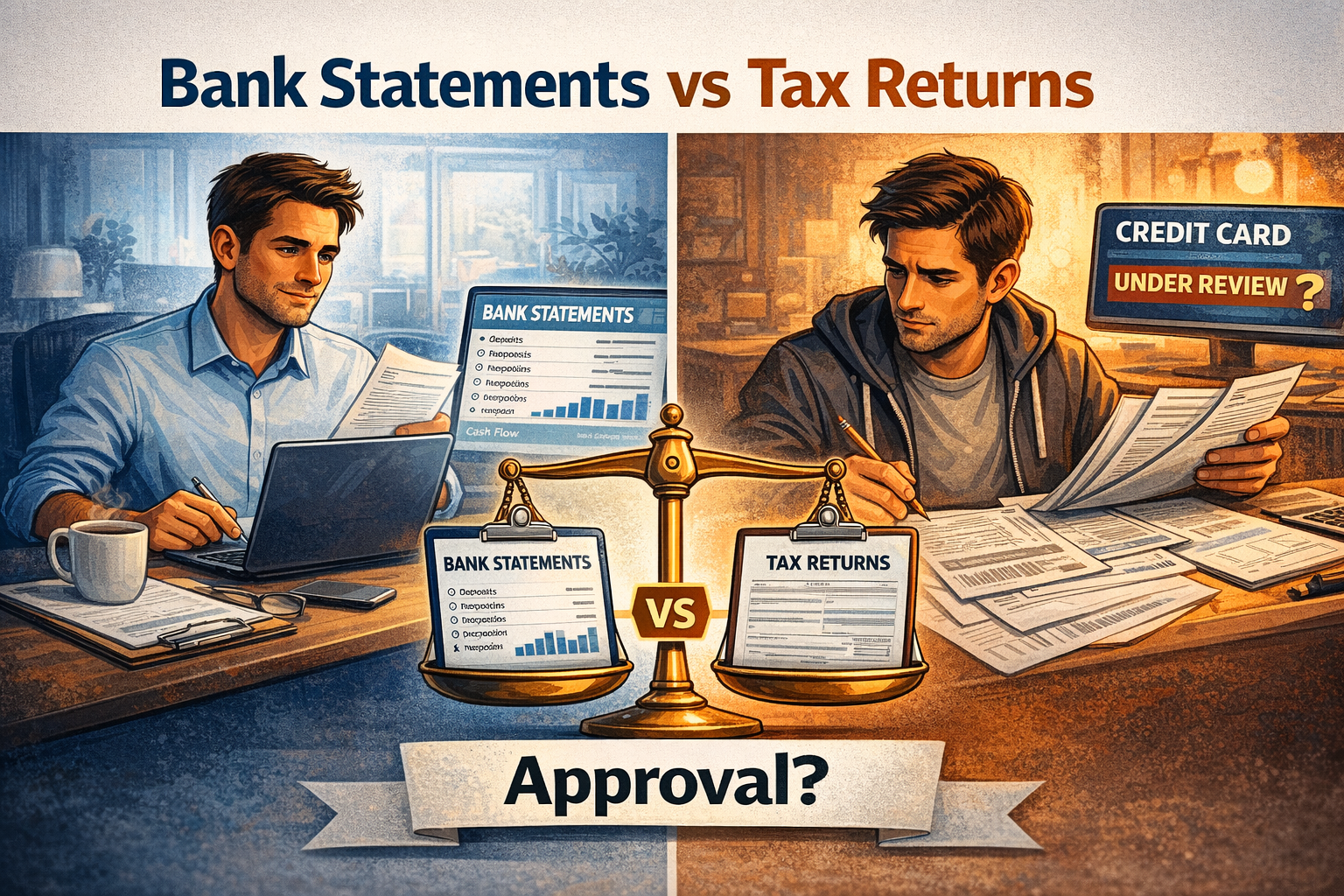
Understanding bank statements vs tax returns credit card approval helps applicants choose the right income documentation. Bank statements and tax returns are not direct substitutes; they answer different questions about your finances. Bank statements are like a live feed of your current money flow, while tax returns are a year‑in‑review snapshot of your total taxable income.
When a lender evaluates you, they may weigh the two documents together. Bank statements help confirm that the income you claim is actively being received now, while tax returns help confirm that you have a track record of earning at that level over time. For example, someone who recently started earning more may have bank statements that look strong but a prior‑year return that still reflects lower income.
Choosing between bank statements vs tax returns credit card approval depends on whether lenders prioritize recent income or long-term stability.
Here is how the two compare on key factors:
| Factor | Bank Statements | Tax Returns |
|---|---|---|
| Recency | Recent | Older |
| Accuracy | Real-time | Verified |
| Stability | Short-term | Long-term |
| Freelancer Use | Strong | Strong |
For income verification credit card approval, bank statements can be more persuasive when your income has recently improved or when you have irregular but frequent deposits that average out to a healthy number. Tax returns become more important when a lender wants reassurance that your income has held up across multiple years, especially at higher credit limits or for self‑employed applicants.
In simple terms, bank statements show current income activity, while tax returns show long-term income stability for credit card approval.
What Lenders Prefer
There is no single rule about whether bank statements or tax returns “win,” because preferences can shift based on the type of applicant and the specifics of the application. However, some broad patterns tend to appear in how issuers use these documents.
Lenders are more likely to lean on bank statements when they want to confirm very recent income or when they have questions about how steady your deposits really are. Short time horizons—such as approving a modest credit limit for someone with a stable history—often pair well with the immediacy of bank data. For applicants whose income has risen sharply since their last filed tax year, strong bank statements can help them make the case for a higher limit.
Tax returns tend to be preferred when a lender is more concerned with long‑term consistency and overall earning power. For self‑employed applicants, issuers often ask for at least one or two years of returns to understand trends and avoid being misled by a single unusually strong month. Higher credit limits, or applications where debt levels already look high, may also prompt a deeper look at tax‑return data.
Lenders prefer recent income clarity from bank statements and long-term consistency from tax returns when making credit card approval decisions. In practice, many issuers will use both: they might ask for bank statements to confirm the income level shown on your return, or to reconcile any differences between what is on paper and what is actually landing in your account. General credit evaluation practices are also explained in financial education resources such as USA gov credit guidance.
Freelancers and Gig Workers
For freelancers, independent contractors, and gig workers, income rarely arrives in a neat, predictable paycheck. You might see a surge of work one month and a lull the next. That variability can make credit card income verification feel especially intimidating.
From a lender’s perspective, the main concern is not that your income is unconventional, but that it is unpredictable. They still want to see that, on average, you earn enough to handle your credit obligations, and that your income has some history behind it rather than being brand‑new. This is where combining bank statements and tax returns can be powerful.
For freelancer income proof credit cards, bank statements for credit card application review can highlight recent client payments, platform payouts, or project fees hitting your account. Over several months, those deposits create a pattern that an issuer can average out. At the same time, tax returns income verification lenders rely on shows the total of those earnings for prior years, smoothing over the month‑to‑month swings and demonstrating that you have made a living this way over time.
For freelancers, bank statements vs tax returns credit card approval becomes more important due to income variability.
If you are a gig worker, it can help to:
- Use a dedicated account for business or gig income, so deposits are easy to see.
- Avoid long gaps with no deposits when possible; even smaller, regular payments can help show ongoing activity.
- File accurate, timely tax returns that reflect your real income, not just a heavily reduced taxable number after aggressive deductions.
The goal is to present income consistency, even if each individual month looks different. A lender who sees both steady annual income in your returns and a recent bank history full of deposits is more likely to view you as a reliable borrower, despite the irregular nature of your work. For more insights, read our guide on credit cards for gig workers and freelancers in the US
Best Strategy for Approval
Because different lenders put different weight on bank statements and tax returns, your best strategy is to be prepared with both whenever possible. Even if the online application form does not initially ask you to upload documents, an issuer may follow up to request them, especially if something about your income or credit profile triggers extra review.
A practical approach includes:
- Submit both documents when possible. If you have relatively stable income, offering both bank statements and tax returns up front can reduce back‑and‑forth and present a clearer picture. You are essentially saying, “Here is what I earned last year, and here is proof that I am still earning at that level (or higher) now.”
- Apply during a stable income period. Try to time your application for a stretch where deposits have been steady for a few months. Applying right after a slow season or gap in work may raise questions, even if your annual income looks fine.
- Keep income consistent. Lenders do not expect perfection, but they are reassured by patterns. Avoid dramatic swings in what you report on different applications; large inconsistencies can trigger manual review or requests for extra documentation.
- Match declared income with documents. The number you type into the income field should be realistic and defensible. If your bank statements or tax returns would not support it, consider using a more conservative figure that aligns with the documentation you could be asked to provide.
For many applicants—especially freelancers and gig workers—this may mean doing some homework before applying: calculating your average monthly income from recent bank deposits and comparing it with the annual income reported on your last tax return. If those numbers are close, you are in good shape. If they differ, be prepared to explain why (for example, a recent raise, a new contract, or a shift from part‑time to full‑time work). In many cases, combining bank statements and tax returns gives lenders both short-term income visibility and long-term financial stability, which can improve approval confidence. Understanding how credit applications are assessed can also be helpful, and additional guidance is available through official resources such as USA government credit advice.
Common Mistakes
Even strong applicants can hurt their chances by mishandling income documentation. Some frequent missteps include:
- inconsistent deposits – Highly erratic account activity with long stretches of little or no income can be hard for a lender to interpret, especially if your application claims a stable monthly figure.
- mismatched income – Reporting an income level that does not align with what your tax returns or bank statements would show can prompt additional questions or even a denial.
- poor documentation – Disorganized, incomplete, or hard‑to‑read documents (such as partial statements or cropped images) can slow down review or force the issuer to rely on more conservative assumptions.
- relying on one document only – Depending solely on bank statements or only on tax returns, when you actually have access to both, limits the story you can tell about your income.
Avoiding these mistakes is mostly about preparation. Before you apply, check what your latest bank statements and tax return actually say, and make sure they tell a coherent, honest story about your earnings.
FAQ
Do lenders check bank statements?
Lenders can check bank statements, especially when the information on your application needs verification or when your income situation is less straightforward. Some issuers primarily rely on self‑reported income for straightforward applications, but they reserve the right to ask for proof—including recent bank statements—if anything looks unclear or risky.
If you are self‑employed, a lender is more likely to request bank statements because they want to see how your income actually arrives over time. That does not mean every applicant will be asked for statements, but you should be ready to provide them if requested.
Are tax returns required?
Tax returns are not always required for credit card applications, but they become more common in certain situations. Lenders are more likely to ask for tax returns when:
- You are self‑employed or have substantial non‑salary income.
- You are requesting a higher credit limit.
- There are questions about the stability or accuracy of your stated income.
In these cases, tax returns income verification lenders use can be the most reliable way for them to confirm your overall earnings and assess your long‑term capacity to repay. Some applicants, especially freelancers and business owners, may even volunteer recent tax returns to strengthen their case.
Which is better for freelancers?
For freelancers and gig workers, neither document is universally “better”—they serve different roles. Bank statements show that money from clients or platforms is flowing into your account right now, while tax returns show that, over the course of a year (or several years), this work has produced a meaningful, taxable income.
In many cases, the strongest approach is to treat both as part of your toolkit for gig worker income documentation. Use tax returns to demonstrate a proven track record and bank statements to prove recent momentum. When both sets of documents tell a consistent story, lenders are more likely to accept your income as reliable.
Does income verification affect credit limits?
Yes. Even if a credit card is approved, stronger and more consistent income documentation can lead to higher starting credit limits, while unclear income may result in lower limits.
Conclusion
For most applicants, income verification credit card approval is less about a single “magic” document and more about presenting a clear, consistent picture of your finances. Bank statements and tax returns simply give lenders different angles on that picture—one focused on recent activity, the other on long‑term history.
Understanding bank statements vs tax returns credit card approval can help applicants present clearer and more consistent income documentation, improving approval chances. When you know what each document shows, and how lenders interpret them, you can time your applications better, choose the right paperwork to submit, and avoid common pitfalls that delay or derail approvals.
Understanding bank statements vs tax returns credit card approval helps improve approval chances with better documentation. Readers who want to explore more credit card insights and approval strategies can visit our credit card education guides.
Disclaimer
This article is for educational purposes only and does not constitute financial, tax, or legal advice. Credit card approval standards and documentation requirements vary by lender, product type, and individual circumstances, and no outcome is guaranteed. Consider consulting a qualified professional about your specific situation before making financial decisions.